• The new B5TV.COM is here. We've replaced our 16 year old software with flashy new XenForo install. Registration is open again. Password resets will work again. More info here.

From AquaTec 8615 to Babylon 5

Skiffy

Member
This thread will cover what I learn about how a manufacturing warehouse in Sun Valley, California became the home of Babylon 5 in the early nineties.

I'm an old-hand 3d modeller with a keen interest in (and some practical experience of) set design. I plan to show how John Iacovelli, John Copeland, JMS and the whole team managed to fit the worlds of Babylon 5 into 60,000 Square feet of warehouse with a 16ft ceiling.
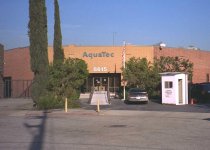
Aquatec_260604.jpg
 
Thanks Dusty Satai. It's interesting to me so hopefully to a few others too. :)

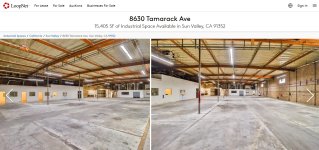
Here's an image from a very similar space in the same compound to help illustrate what the team started with.

Similar listing with pillars.jpg
 
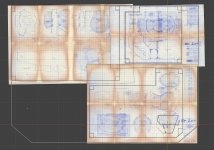
So, one of my first jobs is mapping out how the three sound-stages fit into the available space, along with the offices, prop stores, workshops etc. The images here are collected from material uploaded to the Internet Archive - drawings produced by John Iacovelli and his team.

These are 'dye-line' prints. The originals were drawn in black ink on tracing paper and prints made via a photographic-style process using ammonia and light sensitive paper. I can still remember the smell from producing this kind of print back in the day. :)

Dye-lines.jpg
 
I made a little progress today to familiarise myself with the styles of set dressing used in the series. An awful lot of 'floating' pieces were used, like the overhead beams, pillars, even doors.

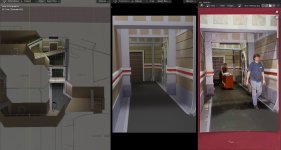
There are no detailed materials in the following screenshot but I've added some very rough colouring to make a start.

From left to right - there's an overhead view of the pieces I'm moving around to get the correct feel - then a 'camera view' of the results - then the on-set photograph I'm using for reference. It looks like the photographer used a 50mm lens which has helped me work out distances etc.

Very much a work-in-progress but it's fun to play with. :)

Corridor_26060702.jpg
 
Seeing your 3D representation of the corridor there makes me wish there was a VR version of the sets that we could walk through. I seem to remember someone did just that for Star Trek TNG's Enterprise-D.
 
Seeing your 3D representation of the corridor there makes me wish there was a VR version of the sets that we could walk through. I seem to remember someone did just that for Star Trek TNG's Enterprise-D.
Thank you Springer. That was my initial intention and still may be do-able, maybe not in VR but definitely as a 3d walk around. I soon realised, though, just how quickly the settings were converted / adapted from scene to scene, sometimes with several setups on the same day. So, apart from a few standing sets there isn't really a fixed plan that folks could walk around.

What I've decided is to focus on one episode over a few days of shooting. I have dated plans by John Iacovelli covering some second season episodes so I'm going to focus on that.

More soon!
 
This will be very helpful when I am wealthy in the future and I have a home made to look like the sets. What are we thinking, C n C as a kitchen OR living room?! I don't know I really like Londo's Kitchen setup, though it is small and I eat a LOT. 😉
 
This will be very helpful when I am wealthy in the future and I have a home made to look like the sets. What are we thinking, C n C as a kitchen OR living room?! I don't know I really like Londo's Kitchen setup, though it is small and I eat a LOT. 😉
Will the Future Home will have LED color panels in the hallways to easily switch "sectors"?
 
Thanks for the interest folks! Back in the day the team built 3 separate soundstages in the warehouse space they had:

'A' stage dubbed the 'Opera' stage housed the Obs Dome, Docking Bay, Central Corridor and the Zocalo.

'B' stage called the 'Swing' stage held the Alien Sector, G'Kar's Quarters, Earharts, The White Star, Down Below and a host of others.

'C' stage, named the 'Drama' stage contained sets for most of the character dialogue scenes, various character's Quarters (re-dressed as required), Zen Garden, Medlab and other smaller sets.

I'm having fun at the moment recreating rag-roll, scumble and faux finish paint schemes which are everywhere in B5. I learned a lot of these techniques myself at college as part of theatre set design. I also know that meny of the furnishings on set came directly from Ikea. If only I had an Ikea catalogue from '93. :)
 
One thing I am curious about, and I know Jason Davies will cover this in his books, is how they had to plan the production schedule around re-dressing sets, like for example Londo's quarters might be re-dressed to become someone else's quarters. I wonder how long it took to do that, and whether that had to be incorporated into the scripts, like if it takes too long to change a set, then to keep to the shooting schedule would a scene have to be moved from someone's quarters to a corridor, for example?
 

Latest posts

Members online

No members online now.
Back
Top